
During this recent Advent season, we used a new book, which we bought especially for the purpose. This book came recommended to us from a variety of places and people, folks and businesses we know and trust. It is part of a trilogy, but I don’t think we’ll be buying the rest of it, and I’m about to tell you why.
Before I go on, here is the book:
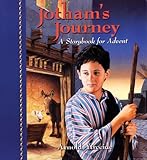
Jotham’s Journey:
A Storybook for Advent
**Spoiler Alert: Spoilers Ahead!**
Before I wrote this post, I asked my husband to email me his opinion. I was very careful not to pollute the well by telling him my opinions first. He began his response with a number of good things about the book, and I agree with all of them. Here is what he wrote:
Good aspects: It has a well-crafted plot line that draws together various elements of the familiar advent story. It has short chapters and many cliff-hangers at the end of each, which makes the kids anxious to keep reading. It has a few comical characters for entertainment. It encourages good morals and discourages bad ones. It emphasizes the primacy of the Scriptures in identifying the general timing of the Messiah’s arrival {applies to both advents, I hasten to add}.
Jotham’s Journey fits neatly into the historical adventure fiction genre. So, while Jotham himself is a fictional character, he is a nephew of Joseph {this is one of those spoilers I mentioned, for this is not evident until later in the book}, who is betrothed to the Virgin Mary. This means he is also a relative of John the Baptist. On his Journey, he also meets some of those other amazing New Testament characters, such as Simeon and Anna. Beyond this, through the reading, we get a bit of a feel for, perhaps, what shepherds were like, what the wise men were like. Jotham even ends up briefly visiting Qumran and meeting the Essenes.
The more knowledge of Scripture, Biblical archaeology, and ancient Israeli history one has, the more one will appreciate the book. Truly, the author was able to weave his story together without compromising the actual events, and for this he should be applauded.
We have, however, two pretty important criticisms. I will start with the lesser, which my husband sums up pretty well:
Some paragraphs call for ad-hoc editing by the reader, especially for small children. The first chapter, for example, includes a few sentiments from Jotham toward his father that I didn’t feel appropriate to read aloud to my children. Also, in two parts of the story, the main bad guy says that he killed his parents. I didn’t read this description aloud the first time, but I did the second time because it seemed more appropriate in the latter context.
This criticism, it must be noted, is pertinent because our children are so young. I really don’t think a family reading this to an 11-year-old would bat an eye. But most 11-year-olds are mature enough to see folly for what it is. Our own children, on the other hand, are still immature and often find books with a strong “hero” who is foolish {even if he later comes to repentance} to be a source of temptation {in the sense that they later imitate the foolish behaviors from the book}. They are, in a word, impressionable. Our daughters, also, are simply too young for a story that turned out a bit scarier than we anticipated.
I suppose I could say that this is what we get for not pre-reading!
In general, there is a difference between having a Frodo-type hero, who is genuinely good, or a Jotham-type hero, who is really struggling with obedience, when it comes to reading with young children. They still need the black and white distinctions. Or, at least, my children still do.
My greater criticism comes from the structure of the book itself and, ironically enough, it is something we also listed as a good point. Remember those cliff-hanger endings my husband mentioned? Well, they are a good thing, I suppose, in the sense that they make a child want to keep reading. But here’s the rub: We didn’t actually sit down and “do Advent” every single evening. Because of this, we were often sitting down to read two or three “days” at a time. The book is structured in such a way that you read the story, and then go through some devotional-type questions at the end.
When we were reading multiple days at a time, the effect was that all of us {except perhaps Si–the author sucked me in as well} were tempted to skip the devotional part and move on with the book. Our two oldest children couldn’t stand the cliff-hangers–they wanted to know what was going to happen right now.
Which means that all of us had varying levels of a particular disease: that of a closed heart. The story, in this sense, became a distraction. We didn’t really want to read the devotions, we wanted to consume the story {and the story is written for the Modern; it is written for the purpose of being consumed, not for being read contemplatively}. We did it {went through the questions}, and it helps that my husband is not as affected by such things as the rest of us, so he kept us under control, but what we really wanted was the next chapter.
I suppose it might be more beneficial if a family were reading one day at a time, but I still think that the anxiety created by cliff-hanger-type chapter endings is counterproductive if one intends to have a meaningful spiritual conversation directly afterwards.
I don’t read much fiction, especially modern fiction, and this is why: it is a huge distraction for me. I can’t put it down. I am tempted to neglect my duties. Part of this says something about modern fiction, but a lot of it really says something about me, and now also the poor children who have inherited the sins and weaknesses of their mother.
With that said, a family will need to consider, at the very least, their own temperament. If they are like some people I know, and easily distracted by a flashy plot line, they may need a tamer book for Advent.
I don’t, by the way, necessarily object to the story itself, though I suspect Charlotte Mason would call it twaddle. It is just that I’d much rather it be a book, and let my children read it. I didn’t find it to serve the purposes of an Advent evening well. It didn’t promote the appropriate solemnity or reverence.
Ah! There is what I’m looking for: propriety. Some things are wrong for the context, and I found that to be the case with this book.
What was that my husband said? Oh, yes:
For something as important as the Incarnation/Advent, I’d prefer a more objective look at the story and associated Scriptures…The fewer distractions from truth, the better.

12 Comments