
I already knew I liked the Grandma’s Attic series when I requested to review the last two books. We’d read the first two, and were ready for more.
Thankfully, the rest of the series did not disappoint!
If you’re unfamiliar with the series, the best way to explain them is to say that they are a little reminiscent of the Little House on the Prairie series. Author Arleta Richardson is sharing not her own experience {which is what Laura Ingalls Wilder did}, but rather her grandma’s experience. Richardson grew up listening to Grandma’s stories of her childhood in the 1880s, and as a woman she wrote them down.
And now they have been published so that all of us may read them!
The Good
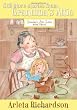 |
| Still More Stories from Grandma’s Attic by Arleta Richardson |
Each chapter stands alone. We like to use the books as a lunchtime read-aloud, munching on a chapter or two before the littles go down for their naps. {Q.-Age-Four loves these books!} Even though the main characters are girls {Richardson’s grandma, Mabel, and her childhood best friend, Sarah Jane}, E.-Age-Nine likes them because they are funny, and sometimes the older brothers do frustrating older brother things, which delights him to no end.
Unlike the Little House on the Prairie books, the Grandma’s Attic books are much more direct about the Christian faith. Also, in almost every chapter, Mabel is learning her lesson about something or another.
My children loved that Mabel made silly, embarrassing mistakes {just like them} and had to confess to her parents {just like them}. And, like a lot of children, they enjoy stories about simpler times where the action involves horses and farming and dolls and sledding and handiwork and the like. In all, we think these books are great and are happy to finally own all four!
The Bad
I have only one complaint about the books, and this deals with how the stories are set up. There are two different narrators {both using the first person “I”} and this confused some of my children–especially A.-Age-Six. Most chapters begin with Richardson’s own childhood voice explaining how she came to hear this particular story. Maybe she herself had a similar experience. Maybe she and Grandma are off visiting her great uncle, Roy, who is featured in the stories as a young boy {Grandma’s older brother}.
The transition from this narrator, to the next narrator–who is Grandma, telling the story of her childhood experience, also in the first person–gets, as I said, confusing. Some of this might have been due to the fact that we were reading during lunch. It is easy to miss transitional cues when other things are going on at the table! Regardless of the reason, we eventually solved this problem by me formally saying, “Okay, now Grandma is going to tell her story.”
This is a slight problem that I would have tried to fix as an editor way back when the books were first published {this is a re-release}. But it didn’t happen, and it doesn’t diminish the value of the books at all.
Note: For you Amblesiders out there, I think this would make a great series to use with little girls if you are building your own Year 0.5 to use as a kindergarten year.
The Great
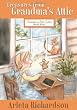 |
| Treasure from Grandma’s Attic by Arleta Richardson |
There is one story that stuck out to me as possibly the most valuable, perhaps due to its uniqueness in children’s literature. The books themselves already encourage children to value grandparents {and older people in general} as persons of interest and sources of wisdom. But there is a chapter in the third volume, Still More Stories from Grandma’s Attic, that is just priceless.
A neighboring family needs to go and care for a family member, and so they leave their aging patriarch, Grandpa Hobbs {who has dementia, or something like it} in the care of Mabel’s family for a while. {This man actually features in at least two of the Grandma’s Attic chapters that I can think of.}
It is a bit strange to the children in the family to have this confused man at their table for meals, and living in their house. He falls asleep at weird times, and is confused when he awakens. He is confused about what decade he’s living in, and remembers days gone by as if they really were only yesterday. And even though the man is odd, Mabel’s parents set a good example of patience and lovingkindness, and the children begin to appreciate hearing some of Grandpa Hobbs’ stories of long ago.
And then Mabel is supposed to be memorizing a passage of Shakespeare from Othello “about a good name,” but she has forgotten her book, and she doesn’t yet know it because she’s only read it once. She’s worried about completing her assignment when suddenly Grandpa Hobbs’ voice, strong and self-assured, rises up:
Good name in man and woman, dear my lord,
Is the immediate jewel of their souls:
Who steals my purse steals trash;
’tis something, nothing;
‘Twas mine, ’tis his, and has been slave to thousands;
But he that filches from me my good name
Robs me of that which not enriches him,
And makes me poor indeed.{Othello, 3.3.155}
The family is stunned. It later comes out that there is a lot more where this came from, including the entire book of Philippians.
The important thing is that my children were stunned. My children gained a greater respect for Grandpa Hobbs that day. My children learned that there was more to him than met the eye. It is hard to teach such things directly, and there are very few opportunities in children’s books to draw out the value of the life of an older person as an older person. This alone makes the book worth its purchase price!
________________________________
Final Note:
Still More Stories from Grandma’s Attic and Treasures from Grandma’s Attic were given to me free of charge by The B&B Media Group in exchange for a frank and unbiased review.
The Grandma’s Attic series includes In Grandma’s Attic, More Stories from Grandma’s Attic, Still More Stories from Grandma’s Attic, and Treasures from Grandma’s Attic.

8 Comments